How the Ring Fury Escalation Takeover Works in Apex Legends


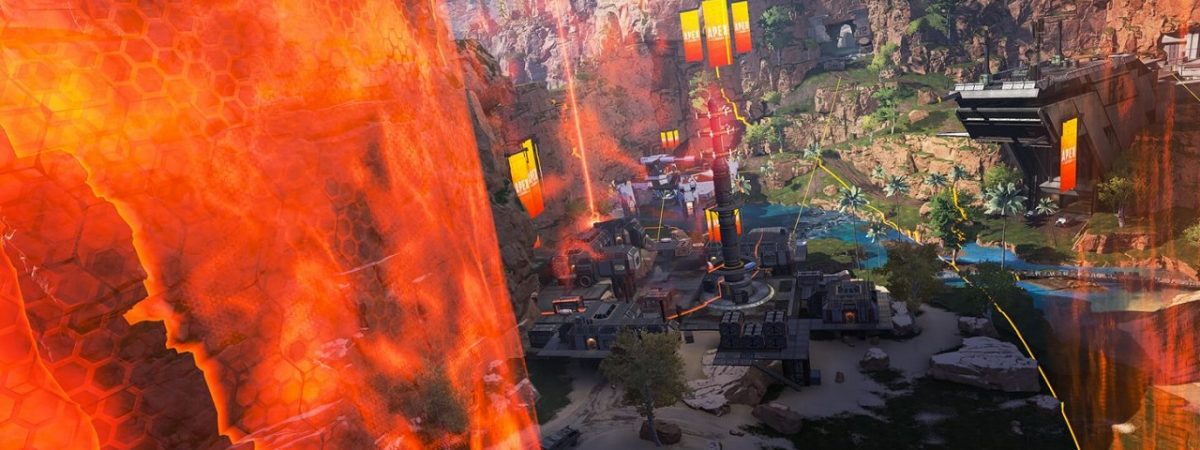


As part of next week’s Chaos Theory Collection Event, Respawn will be introducing a new game mode to Apex Legends. Entitled ‘Ring Fury,’ this mode is being introduced in a brand-new way known as an ‘Escalation Takeover.’
The Apex Legends Ring Fury Escalation Takeover
Like other recent limited-time modes, Ring Fury doesn’t change the basic mechanics of a standard Apex Legends match that much. There are only two aspects which are different in Ring Fury; one major and one minor. The major difference is the existence of ‘Ring Flares.’ While the Ring slowly encroaches inwards during the match, Ring Flares may spawn at random within the safe zone, slowly expanding outwards to form dangerous hotspots.

The other change in Ring Fury, however, is designed to make these Ring Flares slightly easier to deal with. Players will find a new item scattered across the map, turning up commonly in loot; the Heat Shield. This new item, which will remain in the game after the end of Chaos Theory, can be thrown down to create a protective bubble which blocks the damage beyond the Ring. (It even speeds up Revival times and healing item usage while outside the Ring.) Once Chaos Theory ends, Heat Shields will turn up in general ground loot, but they’re more common in Ring Fury.
In recent events, Respawn has launched limited-time game modes through a playlist ‘takeover.’ In these cases, the new mode has taken over the standard Play Apex playlist, replacing the standard game mode for the duration of the event. Ring Fury is a little different. The mode will be replacing the normal Duos and Trios playlists for the duration of Chaos Theory. However, it is part of an ‘Escalation Takeover’ which includes an extra effect. “Every few days during the event,” explains Respawn; “we’re going to turn some knobs to crank up the prevalence, timing, and size of Ring Flares. By the end of the event, you can expect five different stages of escalation.”